


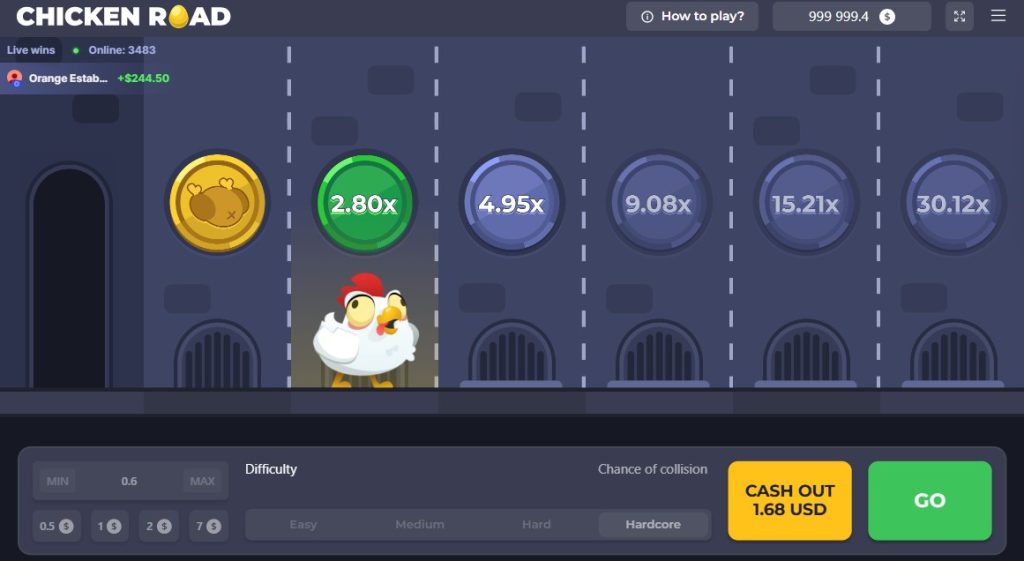
The Chicken Road demo runs the full game with virtual credits — same mechanics, same difficulty modes, same 98% RTP, same provably fair verification. Only the money is fictional. What appears on screen behaves exactly as it does in a real-money session, which is what makes the demo useful in the first place.
Chicken Road is a crash-style casino title from InOut Games. A chicken advances across a lane sequence, the multiplier climbs step by step, and the round ends the moment the crossing fails or the player cashes out. That’s the entire loop. The demo strips away the deposit process and the real stakes but leaves everything else intact: bet controls, mode selector, cash-out mechanics, seed verification, auto-play settings.
Demo play is the right entry point for anyone new to the format. It removes the pressure of a real bankroll from the learning curve, opens up direct comparison between the four difficulty modes, and lets a player walk through the provably fair verification process without any funds at risk. What follows is a practical guide to getting the most out of that time before moving to real-money play.
What the Chicken Road demo is
The Chicken Road demo is a virtual-credit version of the game, running on the same engine and RNG that powers the real-money title. It’s not a lite version, a preview, or a mock-up — it’s the actual game with fictional currency substituted for real funds. Every mechanic behaves identically.
Feature parity with the real-money game
Everything from the paid version is present in the Chicken Road game demo:
- All four difficulty modes — Easy, Medium, Hard, and Hardcore all available from launch
- Auto-cash-out — pre-set target multipliers work the same as in real play
- Full stake range — bet sliders operate across the standard $0.01–$200 range, only using virtual credits
- Provably fair panel — server seed hash, client seed, and nonce accessible and verifiable
- Sound and visual settings — identical interface, identical animations
- Same 98% RTP — the return figure applies to demo rounds because the math is unchanged
What virtual credits look like
Most host operators start the demo player with a substantial virtual bankroll — typically between $1,000 and $1,000,000, depending on the site. That figure is generous by design. It gives a new player enough runway to sample all four difficulty modes, run multiple sessions at different stake sizes, and walk through a provably fair verification cycle without any pressure to conserve credits.
Some operators refresh the virtual bankroll automatically when it depletes; others require a manual reset via the demo menu.
Why the demo exists
For the operator, the demo functions as a low-friction sampler that converts curious visitors into registered accounts. For the player, it’s something more useful: a risk-free environment to learn a game whose mechanics feel simple but whose difficulty modes behave quite differently in practice. The Chicken Road demo is one of the more honestly-built demos in the crash category — nothing is watered down, no features are locked behind registration, and the outcomes are generated by the same seed system that runs the real game.
Demo vs real-money play — what actually changes
The demo runs the same game as real-money play. The math is identical, the animations are identical, the mechanics are identical. What changes is the player.
The behavioural gap
Most people bet differently in a Chicken Road game demo than they would with real funds, even when they intend not to. Virtual credits reduce the emotional weight of each round, and that reduction shows up as measurable shifts in behaviour:
| Behaviour | Demo tendency | Real-money tendency |
|---|---|---|
| Stake sizing | Larger — credits feel infinite | Smaller — every unit matters |
| Cash-out timing | Later — extra lanes cost nothing | Earlier — the current multiplier feels safer |
| Reaction to a bust | Neutral — reset and go again | Frustrated — impulse to raise stakes |
| Mode selection | Adventurous — Hardcore feels fun | Conservative — Easy or Medium |
| Session length | Short — no financial pressure | Longer — chasing recovery |
None of these shifts are conscious. They emerge naturally from the difference between clicking through virtual credits and watching real funds move.
Why demo results don’t predict real sessions
A player who runs a fifty-round demo in Hardcore and finishes ahead does not have a strategy that works. What they have is a fifty-round sample, at a stake size and stress level that doesn’t match real play. The 98% RTP guarantees that over a statistically large sample the game returns 98% of what’s wagered — but “large enough” means tens of thousands of rounds, not fifty. A demo session sits well inside the noise range where anything can happen.
The useful function of the demo is teaching the mechanic and testing the interface, not validating a strategy. Any pattern that appears to work in demo will re-run its real luck in real-money play — sometimes for, sometimes against.
Common mistakes in demo play
Most of what goes wrong in demo mode comes from treating the demo as either less useful than it is, or more useful than it is. A few patterns show up repeatedly:
Betting recklessly because credits are fake
The most common demo mistake is running stakes far higher than the player would ever use in real play. It feels harmless — the credits regenerate — but it teaches nothing transferable. A demo player who plays $50 per round in Hardcore, wins big, and then deposits real money at $50 stakes is heading straight into a bad session. Match the demo stake to the stake the player actually intends to use with real funds.
Sampling only one difficulty mode
A player who runs a hundred rounds in Medium and skips the other three modes has learned about a quarter of what the game offers. The whole point of the four-mode design is that they behave differently — sampling only one leaves the player unprepared for the rhythm of the others. Run the full drill across all four before deciding which one to commit to.
Treating demo wins as validation
A profitable demo session doesn’t prove a strategy. It proves that fifty or a hundred rounds of a random-outcome game happened to break in the player’s favour. The 98% RTP holds over a statistically large sample, and a single demo session is nowhere near that sample size. Assume the pattern won’t repeat, because it usually won’t.
Skipping the provably fair walkthrough
The demo is the ideal environment to walk through seed verification without any funds at stake. Most players never do it. The result is a real-money session where the player theoretically has verification available but has never actually used it — which means the trust benefit of a provably fair system stays theoretical.
Playing too long
The demo is a mechanic tester, not an entertainment product. Once the four modes have been sampled and the interface is familiar, further demo rounds add little. Playing for hours in demo before ever depositing usually signals hesitancy about the real game — which is worth listening to. Either commit or step away.
Demo mode limitations
The Chicken Road demo replicates the game itself faithfully, but the demo experience is only a slice of what real-money play involves. A few things the demo Chicken Road cannot show:
- Real withdrawal experience. How fast a specific operator pays out, what verification documents they require, how their support team responds to a query. All of that is only visible on the real-money side.
- Bonus interactions. Welcome bonuses, deposit-match play-through requirements, wagering contribution rates, and bonus-restricted game lists apply only to funded accounts. If Chicken Road is excluded from bonus wagering at a given operator, the demo won’t reveal that.
- Session-scale variance. A few hundred demo rounds is nowhere near the sample size where the 98% RTP begins to hold reliably. Any pattern that appears in a short demo session is inside the noise range — not signal.
- Account-level friction. KYC checks, deposit limits, cooling-off periods, and responsible-gambling tools only engage on real-money accounts. Their presence or absence at an operator is worth knowing before depositing.
- Emotional weight. The most significant limitation. The demo can’t reproduce how it feels to watch real funds move through a losing streak. That reaction is a large part of whether a player enjoys the game or not, and no amount of demo play prepares for it.
The demo does one job well: teaching the mechanic. Everything above sits outside that scope and can only be tested by moving to a small real-money session.
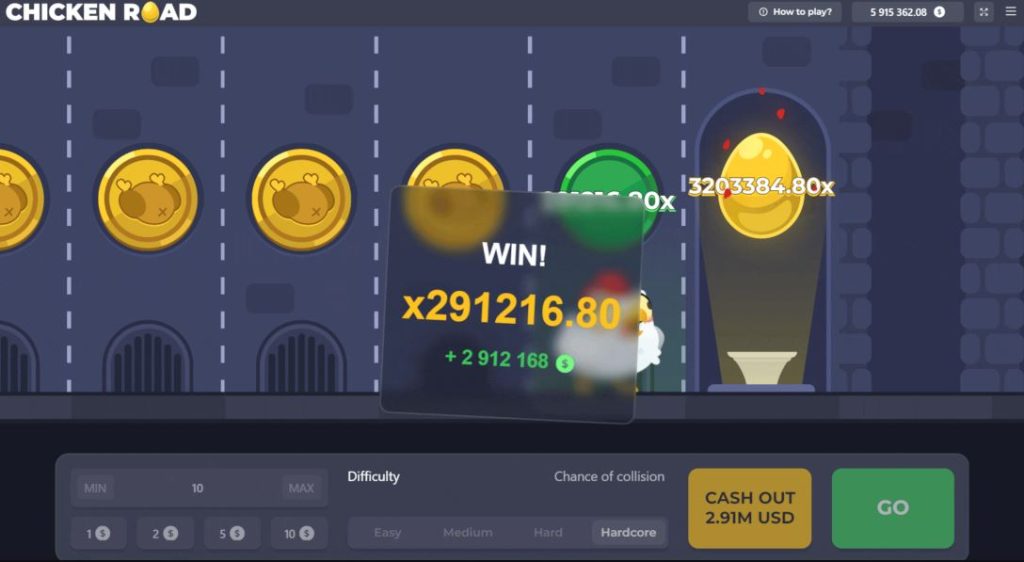
Moving from Chicken Road game demo to real money
The move from demo to real-money play is worth treating as a deliberate step rather than a natural continuation of a demo session. A few practical framings help make it a considered decision.
Set the session budget first
Decide on a loss ceiling before opening a deposit page — not a target win figure, a loss ceiling. Deposit that amount and nothing more. This is the single most useful discipline in any crash-game session, and it’s the one demo play doesn’t teach because the credits never actually run out.
Match real stakes to demo stakes
If the demo drill was run at $1 stakes, the first real session should also be run at $1 stakes. A player who tested at $1 and then deposits at $10 has thrown out the calibration the demo provided. Real money changes decision-making regardless — no need to compound that by changing stake size too.
Start with the mode that felt most sustainable
The three data points from the demo drill (average cash-out lane, reaction to a losing streak, which mode felt right) point to a starting mode. Use that one. Don’t start with the mode that produced the biggest demo win — that’s chasing variance, not applying the lesson.
Keep the first session short
Thirty minutes at real stakes teaches more than three hours of Chicken Road demo play. Set a timer, stop when it goes off, and reassess before committing to a longer session. Chicken Road rounds resolve in seconds — thirty minutes covers enough rounds to test whether the demo calibration held up under real conditions.
Conclusion
The Chicken Road demo is one of the more useful demos in the crash-game category — full mechanic parity with the real-money version, no watered-down features, and no registration required at most operators. That combination makes it the right entry point for anyone approaching the game for the first time.
The value comes from using the demo deliberately: sampling all four difficulty modes, matching demo stakes to intended real-money stakes, walking through the provably fair verification, and reading the results as a mechanic test rather than a strategy validation. Done that way, an hour of demo play produces a real read on whether the game suits a given player’s temperament, and at what mode and stake a first real session should start.
What the Chicken Road demo play cannot do is prepare a player for the emotional weight of real funds moving through a losing streak. That side of the game only reveals itself when real money is on the table — which is why the first real-money session should be short, budgeted, and calibrated against what the demo drill actually taught.
FAQ
Do I need an account to play the Chicken Road demo?
It depends on the operator. Non-UKGC casinos like Stake typically launch the demo directly in the browser with no registration. UKGC-licensed operators generally require an account before any game launch, though the registration itself is quick and the demo unlocks fully once in.
Can I win real money playing the demo?
No. Demo rounds pay out in virtual credits only. Nothing that happens in the demo affects a real-money balance, and virtual winnings cannot be withdrawn or converted.
Does the demo have the same RTP as the real game?
Yes. The demo runs on the same engine and RNG as the paid version, which means the 98% RTP applies to demo rounds identically. The math is unchanged — only the currency is fictional.
Does the demo work on mobile?
Yes. The Chicken Road demo runs in HTML5 through any modern browser on Android and iOS, with the same mechanics and interface as the desktop version. No app required.
Are demo outcomes provably fair?
Yes. Each demo round produces a server seed hash, client seed, and nonce identical to real-money rounds. The provably fair verification process works the same way in demo mode, which makes it a good environment to walk through seed checking without any funds at stake.